

Data is finally affordable
Whole‑genome and performance‑linked measurements are now inexpensive enough to build large, paired datasets at commercial scale—something only a few players could afford until recently
Finish Line Bio has built a genome-to-yield learning engine for industrial biotechnology, generating the ground truth linking genetic changes to product yield. We uniquely identify the hard- and impossible-to-predict genetic changes that contribute meaningfully to product formation. When you don't know what other genetic changes to make - we do.
What this means...
For biomanufacturing companies working with E. coli and yeast, making chemical or protein products in fermentation - we deliver about 2 dozen validated genetic edits for your strain in about 3 months.
In case studies, genetic edits improved naive strains by 40% - 90%; over 70% of genetic edits we identified were hard or impossible to predict.
(Hard to predict: could be explained post-hoc; Impossible to predict: genes of unknown function, or known, wholly-unrelated function.)
We don't need your strain, the engineering you've already done, or your data on strain performance or 'omics. For chemical products: we optimize for the product itself (if native) or the last, naturally-occurring metabolite in the pathway before any heterologous enzymes to make your product. For protein products: we minimally need the gene sequence; we expect superior results if we use your plasmid or insertion cassette.
Our INTRODUCTORY OFFER: for a modest initiation fee, we identify genetic edits validated to improve the yield of your target product in approximately 12 weeks, and provide them for a one-time license fee.
Unlike standard 'omics-driven ML tools or foundry optimization servies, we focus on yield economics and host‑genome decisions. FLB works alongside your internal R&D, foundry, or CRO to find novel, non-obvious host‑genome edits.
Talk to us to find out how we can help - our technology is ready to be put to work.
Coming soon:
Getting from a working strain to a competitive cost of goods takes years of iterative trial and error, as improvements get smaller and harder to find over time — and most companies never get to economics that are market-competitive.
Over a hundred billion dollars have been invested in biomanufacturing ventures. The majority failed because they ran out of time and money before reaching economic production. Rapid iteration and massively parallel experiments aren't going to break barriers; something new is needed.
The tools exist to build strains. What’s missing is the intelligence to turn a working strain into a top‑performing one, fast. Finish Line Bio's intelligence layer is not biased by previous engineering projects; it is unbiased across pangenomic diversity. We find genetic targets hiding in plain sight. Not a foundry. Not just sequence or structure. An intelligence built for function.
We measure how microbial strains perform, and use our data to train models that pinpoint which specific genetic features are associated with higher output — and by how much. The genetic edits we recommend are ranked by impact and confidence.

Genetic and performance data combined across deeply diverse, pangenomic contexts.
ML/AI models estimate production impact and confidence for every genetic feature.
License edits, order CRISPR reagents, or have us build the strain.
A ranked, searchable catalog of genetic changes — each with a predicted production impact and a confidence score. We provide and license the relevant edits for your application.
Genetic associations are far more robust than conventional analysis — without overclaiming causality. The output isn’t a hypothesis. It’s an add-to-cart button for yield improvement.
Every gram of titer in the fermenter starts with a decision in the genome.
Whole‑genome and performance‑linked measurements are now inexpensive enough to build large, paired datasets at commercial scale—something only a few players could afford until recently
After years of ‘lower the cost of R&D,’ the pressure is now squarely on ‘prove the economics’—and strain optimization sits on the critical path to cost‑competitive biomanufacturing.
Robust ML methods for finding signal in sparse, high‑dimensional genomic data are now mature and battle‑tested, giving us a solid computational foundation to build on.
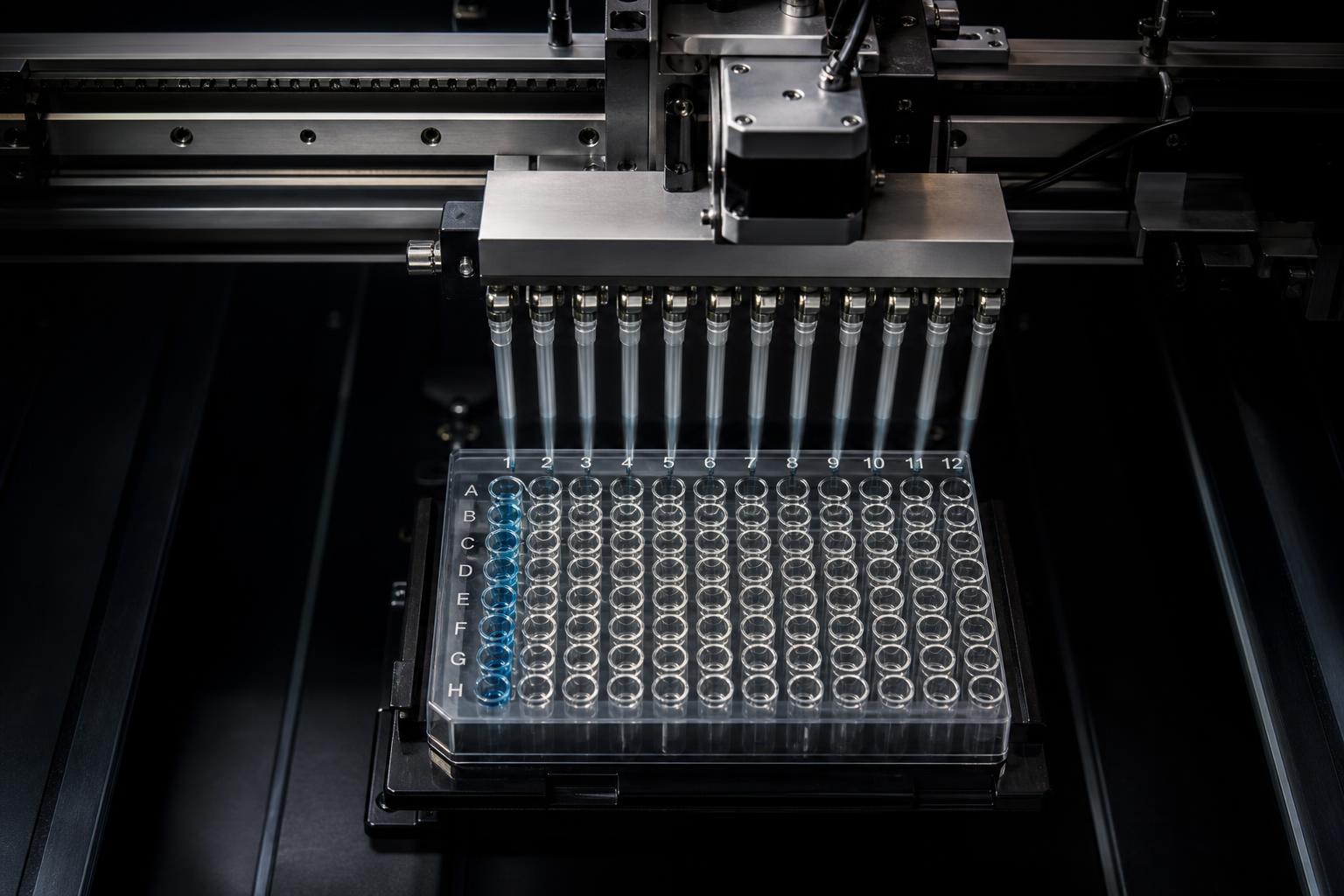
Every experiment moves the model and every model run sharpens the next experiment.
Previous decades have been about accelerating and automating engineering so that strain engineers can test more ideas. Finish Line Bio builds the unbiased, data-backed intelligence to find your next move. Ask us how. The next evolution of strain engineering is here and ready for you.
We’re onboarding pilot customers and select CRO, foundry and autonomous lab channel partners. If you work with E. coli or yeast production strains and care about time-to-market and breaking through yield plateaus, we’d like to talk.